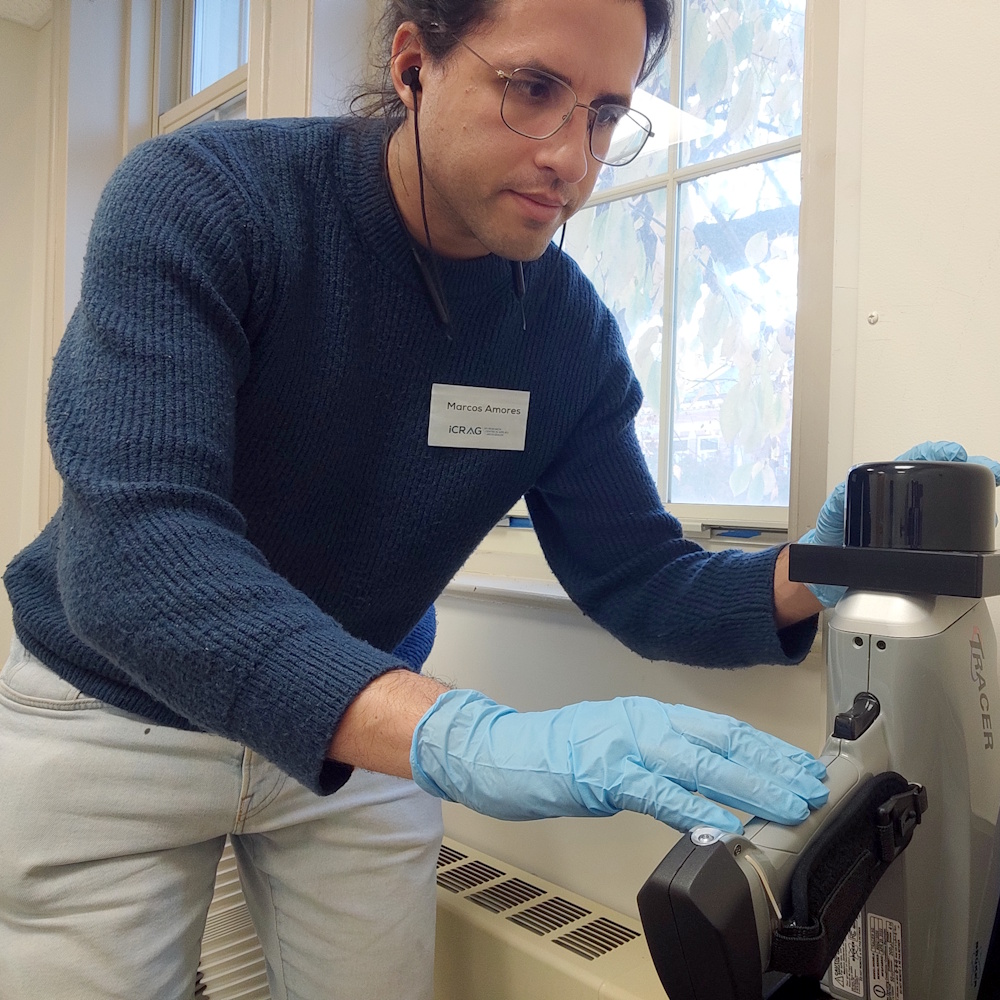
Image description: Marcos placing the radiation shield on a mudrock sample for major and minor elemental analysis with X-ray fluorescence at the University of Connecticut, USA. Marcos is a while man with long brown hair that is tied up in a top knot and is wearing glasses, a blue sweater, and nitrile gloves.
Marcos Amores
Ireland
October 20, 2026
Reconstructing terrestrial ecosystem recovery and climate change in Early Triassic Australia following the Great Dying
How quickly can ecosystems recover from a mass extinction, and how do they respond to prolonged climatic instability? Around 252 million years ago, Earth experienced its most severe mass extinction, followed by millions of years of environmental upheaval. Yet, how terrestrial ecosystems responded to these changes remains poorly understood. In this talk, I combine fossil pollen and spores, carbon-isotope geochemistry, clay mineralogy, and elemental abundances to reconstruct vegetation changes and chemical weathering trends in the Early Triassic of Australia. Our findings reveal that plant communities recovered remarkably quickly, within 100,000 years, but underwent repeated reorganizations during subsequent episodes of extreme warming and cooling. These records provide insights into how climatic instability shaped terrestrial ecosystems and landscapes over millions of years.

