
Image description: Photo of Sinjini, a young, brown-skinned woman with black eyes and black hair, wearing a navy-blue blazer and brown scarf, standing in front of a lake in
Chicago.
Sinjini Sinha
University of Texas, USA
October 8, 2024
Ecological Impacts of Early Jurassic
Climate Crises [in Morocco]
The Pliensbachian/Toarcian boundary event (~184.2 million years ago) and the Toarcian Oceanic Anoxic Event (TOAE, ~183 million years ago) represent two of the most severe environmental perturbations of the Early Jurassic Epoch, leading to global marine ecosystem disruption and biotic crises. Previous work on these crises has implicated warming-induced anoxia as the primary driver for the extinctions. Recent studies, however, show elevated extinction rates in well-oxygenated basins. In our current study, we use basin-wide sequence stratigraphy to correlate the occurrence, abundance, and diversity of the level-bottom communities (e.g., bivalves, brachiopods) across multiple sections in the Central High Atlas Basin of Morocco. Our data shows the Pliensbachian/Toarcian boundary event or the Toarcian event has no significant impact on the diversity of the Moroccan-level bottom communities during the studied interval. We hypothesize the Central High Atlas Basin was a refugia for macrofaunal communities. The new macrofaunal data from tropical, shallow-water sections in Morocco are critical to our understanding of organism survival during the severe Early Jurassic climate crises. These data would also aid in the development of modern-day marine conservation plans for projected biodiversity crises.

Image description: Stéphanie Bodin, postdoc researcher, drinking Ethiopian coffee with a Stephania liana on her cap
Stéphanie Bodin
Senckenberg Research Institute
and Natural History Museum, Germany
October 15, 2024
Charcoal identification to reconstruct paleovegetation
and past woodland management
Charcoal is very useful: it can be used for dating, reconstructing fire regimes, but also for reconstructing past woody vegetation and past forest management!
Join me at this Pal(a)eoPERCS seminar and I’ll tell you more, with a special focus on the tropics!
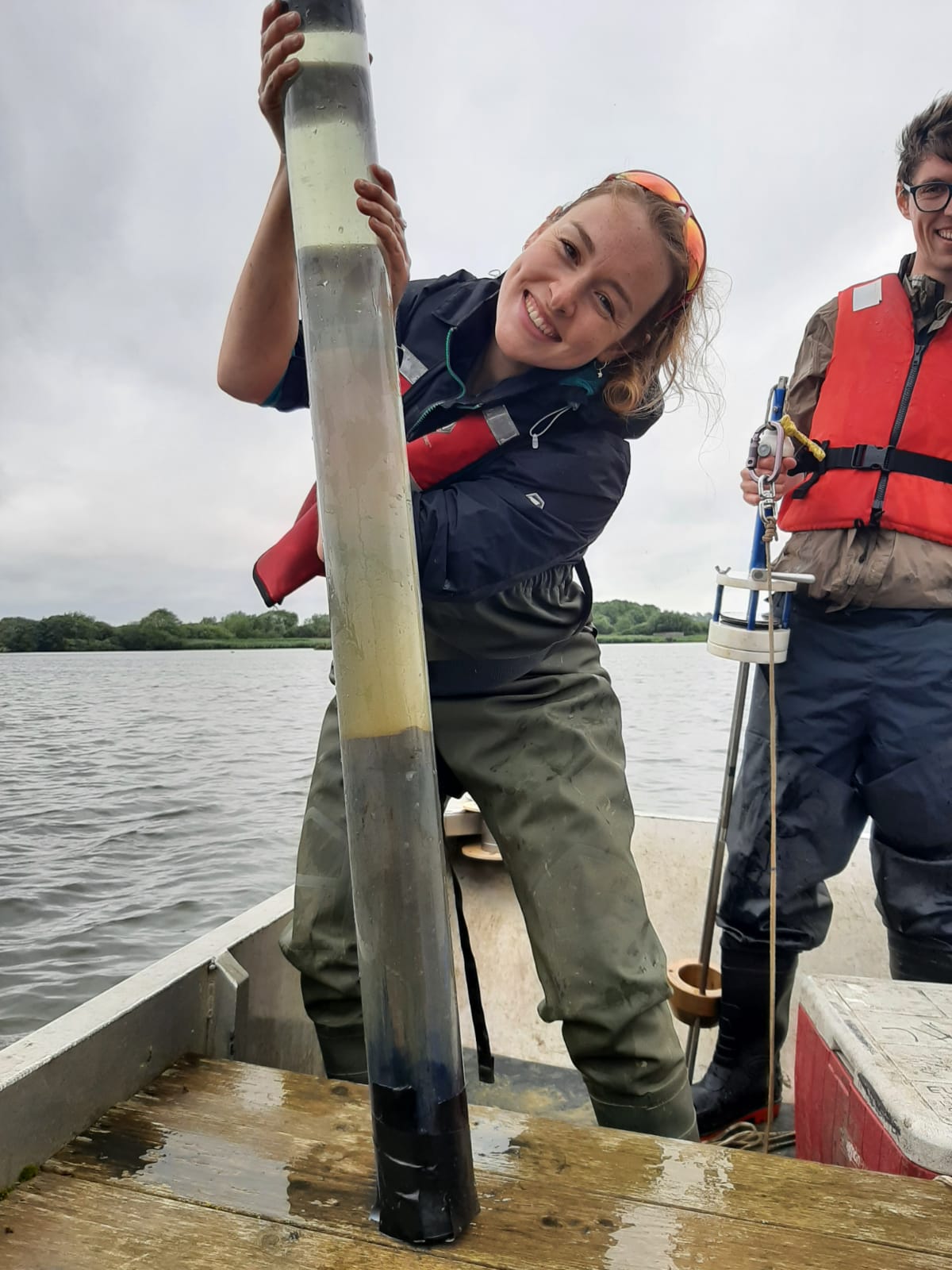
Image description: Picture of Savannah, a white woman wearing cargo pants and a jacket. She is standing on a boat in a lake, smiling while supporting a long cylindrical core of lake water and sediment.
Savannah Worne
Loughborough University, UK
October 22, 2024
Using Palaeoenvironmental Techniques to Evaluate the Role of Sewage Management and Legacy Pollution on Algal Blooms in Standing Waters: a case study at Rutland Water Nature Reserve
Sewage effluent is a major contributor to nutrient enrichment (eutrophication) in aquatic ecosystems across the UK. However, there remains uncertainty about the effectiveness of tertiary treatment practices in reducing nutrient loading in standing waters (such as lakes, ponds, and lagoons), and their consequent impact on ecological health. With future climate change, sewage-related eutrophication is expected to exacerbate ecological impacts, including the increased intensity and duration of harmful algal blooms (cyanobacteria). In this presentation, I will share my fellowship research, which utilises palaeoenvironmental techniques to reconstruct nutrient loading and algal bloom histories at Rutland Water Nature Reserve. This study evaluates the long-term interactions between nutrient management and ecological quality. Findings indicate that changes in tertiary treatment, made to meet nutrient targets set by the Urban Wastewater Treatment Directive, have directly influenced the nutrient balance of the affected lagoon, leading to more intense and toxic harmful algal blooms.

Image description: Antoine Champreux in Anchor court on Flinders University’s campus.
Antoine Champreux
Flinders University, Australia
October 29, 2024
Combining the fossil record and computer simulations to study the effects of climate change on South American ecosystems after the last ice age
The last Ice Age ended around 19,000 years ago and was followed by a global warming that lasted around 7,000 years, giving rise to major vegetation changes on all continents. It was during this warming period that South America saw most of the large animal species that used to populate it disappear, and human population densities explode. However, the extent of the changes in vegetation, the effect of humans on nature and the causes of megafauna extinction are still poorly understood. In this presentation, I will summarise the work I carried out during my PhD thesis, in which I combined information from the fossil record and computer simulations to study the effects of climate change on post-Ice Age ecosystems in South America.

Image description: Two images of Imran stitched together. Image to the left is Imran offshore, standing on the helideck with the rig in the background, location offshore West Africa. Image to the right is Imran presenting at AAPG/GESGB BEOS 2024 conference. Representing young professionals within the energy industry, outlining our mission to foster a positive networking platform dedicated to advancing knowledge and collaboration within the field of geoscience, raise awareness of a skill shortages, and to address misconceptions about the energy industry.
Imran Ali
PetroStrat, UK
November 5, 2024
Fossils in Focus: My Career, so far, in micropalaeontology
In this career talk, Imran will share his journey as a Micropalaeontologist and Stratigrapher, reflecting on his roles in both research and the energy industry. From his academic research to applied stratigraphy projects with PetroStrat and Viridien, he will discuss how micropalaeontology has driven impactful projects worldwide. Imran will cover both challenges and successes, including pivotal career choices, good and bad, and the lessons each has taught him. By keeping his reflections transparent, he aims to provide insights into how he entered the industry and realities of working in this field, including what he might do differently if starting over. This talk will offer a balanced perspective on pursuing a career in micropalaeontology, highlighting both the rewards and the lessons that have shaped his path.
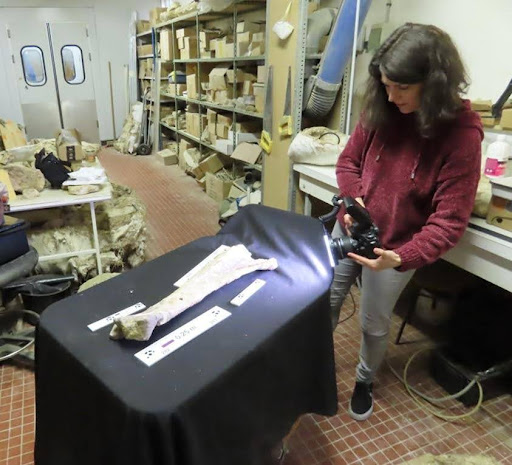
Image Description: Verónica Díez Díaz, with a burgundy sweater and grey jeans, taking photos of a long fossil bone which is surrounded by four scale bars, on a table covered by a black cloack. The background is a fossil preparation laboratory, full of fossils and boxes.
Verónica Díez Díaz
Museum for Naturkünde, Germany
November 19, 2024
Ethics and Technology in the 21st Century
Fossils are very useful tools for learning about our planet’s past, but they often have a very intimate connection to our own history and are not usually made public, at least not in detail. The Late Jurassic Tendaguru dinosaur collection of the Museum für Naturkunde is a perfect example, as it contains very important information about German colonial practices in Tanzania in the early 20th century. To improve the accessibility and transparency of this collection and its colonial history, a multidisciplinary team is carrying out a project which, among other protocols, is digitising the dinosaur fossils in 3D.

Image Description: A photograph of Petter Hällberg standing in a blurry forest and smiling.
Petter Hällberg
Stockholm University, Sweden
November 26, 2024
Droughts, flooding and wildfires: disentangling seasonal and annual precipitation signals in the tropics over the Holocene using δD, alkanes and GDGTs
Rainfall seasonality in the tropics has a substantial impact on both ecosystems and human livelihoods. Yet, reconstructions of past rainfall variability have so far generally been unable to differentiate between annual and seasonal precipitation. Past variations in seasonality are therefore largely unknown. Here, we disentangle hydrogen isotopic (dD) signals from terrestrial leaf waxes and algae in an 8000-year peat core from Sumatra, which reflect annually integrated versus wet season signals, respectively. We validate these results using lipid biomarkers by reconstructing vegetation dynamics via n-alkane distributions and peatland hydrological conditions using glycerol dialkyl glycerol tetraethers (GDGTs), as well as biomass burning using levoglucosan concentrations in the core. In this talk, I will discuss our findings on Sumatra and how seasonality can be interpreted in the paleorecord.

Image description: A photo of Netta Shalev standing with a backpack and sunglasses at a viewpoint overlooking Wadi Zin in the Negev Desert, Israel. In the background, a marine sedimentary sequence is visible, ranging from the Late Cretaceous (on the left) to the Eocene (on the right).
Netta Shalev
Hebrew University, Israel
December 3, 2024
Tracing Past Oceanic Mg Budget with Mg Isotopes
In this seminar, I will focus on the oceanic budget of magnesium (Mg). Magnesium is primarily supplied to the ocean through chemical weathering via rivers and groundwater, and it is removed mainly through the formation of Mg-rich carbonates (mostly dolomite) and hydrothermal reactions within the oceanic crust. The balance between these fluxes determines the concentration and isotope composition of Mg in seawater. These fluxes, in turn, are governed by fundamental Earth-system processes, such as weathering, volcanism at mid-ocean ridges, and biological and sedimentary processes. Thus, if we can use the sedimentary record to reconstruct the chemical and isotopic evolution of Mg in seawater, we can gain a better understanding of the global evolution of the Earth’s surface environment.
I will demonstrate how magnesium isotopes (δ²⁶Mg) can be used to constrain the oceanic Mg budget, with an example from the past ~20 million years. I will also discuss a major current limitation in the field—reliable archives—and suggest potential solutions.

Image description: This is a photo of a person standing on a wooden platform with a scenic background featuring a pristine, turquoise lake surrounded by snow-capped mountains and evergreen trees. The individual is a brown woman wearing a black jacket, black leggings, boots, and glasses, smiling warmly at the camera.
Maria Hussain
University of Manitoba, Canada
February 4, 2025
Ear-resistible Insights: What Can a Fish Ear Stone Tell Us About the World?
Fish otoliths, calcified structures found in the inner ear of fish, record the chemical signatures of the surrounding environment, creating a detailed history of ecosystem conditions. My research focuses on understanding how mining-related pollutions disrupts biomineralization processes in modern fish otoliths. Advanced geochemical techniques, such as laser ablation inductively coupled plasma mass spectrometry (LA-ICP-MS) and electron microscopy, are employed to analyze the incorporation of trace elements, assessing the physiological and ecological impacts of contamination. In the future, similar methods will be applied to Late Cretaceous sediment samples to identify fossil otoliths from the Western Interior Seaway, which could provide valuable insights into ancient ecosystems.

Image description: The photo shows Jack working aboard the French research vessel Thalassa in the Northwest Atlantic near Flemish Cap. He is wearing heavy-duty black overalls and sub-sampling water from bottles attached to a rosette—a metal frame lowered to the seafloor by cables. The ocean is visible in the background. Photo credit: Dr Simon Wett, University of Hamburg.
Jack Wharton
University College London, UK
February 11, 2025
Deeper and Stronger North Atlantic Gyre During the Last Glacial Maximum
Subtropical gyre (STG) depth and strength are controlled by wind stress curl and surface buoyancy forcing. Modern hydrographic data reveal that the STG extends to a depth of ~1 km in the Northwest Atlantic, with its maximum depth defined by the base of the subtropical thermocline. Despite the likelihood of greater wind stress curl and surface buoyancy loss during the Last Glacial Maximum (LGM), previous work suggests minimal change in the depth of the glacial STG. Here we show a sharp glacial water mass boundary between 33 and 36°N extending down to ~2-2.5 km—approximately 1 km deeper than today. Our findings arise from benthic foraminiferal δ18O profiles from sediment cores in two depth transects at Cape Hatteras (~36-39°N) and Blake Outer Ridge (~30-33°N) in the Northwest Atlantic. This result suggests that the STG was deeper and stronger during the LGM than at present, which we attribute to increased glacial wind stress curl, as supported by climate model simulations, as well as greater glacial production of denser Subtropical Mode Waters. Our data suggest: (1) that subtropical waters likely contributed to the geochemical signature of what is conventionally identified as Glacial North Atlantic Intermediate Water, and (2) the STG helped sustain continued buoyancy loss, water mass conversion, and northward meridional heat transport in the glacial North Atlantic.

Image description: Niklas Hohmann smiling into the camera. The picture is taken in the winter on a mountain and his eyebrows are frozen
Niklas Hohmann
Utrecht University, Netherlands
February 18, 2025
Recovering Trait Evolution From Incomplete Carbonate Successions
The fossil record provides a unique opportunity to examine evolutionary change. However, due its incompleteness, many biologists are skeptical of the usage of fossil data. Simulations of geological processes can be used to examine the effects of the incompleteness in silico, thus providing stratigraphic null hypotheses against which empirical data can be compared. We combine simulations tropical carbonate platforms with different modes of trait evolution (stasis, (un)biased random walks) to determine (1) how well the original signal can be recovered from fossil data, (2) how preservation varies spatially within the platform and (3) differences between platforms controlled by different eustatic sea level curves.
Visually, we find that not incompleteness, but maximum hiatus duration has the strongest influence on the preservation of trait evolution. Gradual, directional evolution is more susceptible to the effects of gaps, making it appear as punctuated evolution when long hiatuses are present. We find that incomplete sections with regular hiatus frequency and duration are suitable to preserve evolutionary history without major stratigraphic biases. Gap duration and frequency is driven by external controls on stratigraphic architectures such as fluctuations in sea level. Understanding these controls is thus key to reconstruct evolutionary history from fossils.
Shraddha Bhurkunde
March 11, 2025

Image descirption: Shraddha Bhurkunde, STEM Educator and Communicator
Beyond Academia: Navigating a Career in STEM Education and Communication
The academic path is often seen as the default for researchers, but many fulfilling careers exist beyond it. In this talk, I will share my transition from paleoscience research to STEM education and communication. I’ll discuss the skills that helped me make this shift, the challenges and opportunities I encountered, and my vision for the road ahead. Whether you’re considering alternative careers or just curious about what’s out there, this session will offer insights into navigating a non-academic career in science.
Sourav Adhya
March 18, 2025
Image description: Sourav Adhya during a brief pause during a morning hike with a friend to Rumtek Monastery, Sikkim, in North East India.
Role of Floodplains in Securing organic-carbon Stabilization in Continental Margins: Implications for global carbon cycle
Organic carbon (Corg) burial at continental margins has been a major driver of atmospheric CO2 drawdown on geological timescales. However, very little attention has been given to the locus of Corg stabilization and the role of the intermediary component- the floodplains. Using carbon and oxygen isotopic composition, soil texture, and mineral oxides, we show that in the upper reaches, vegetation type plays a major role where climatic conditions are arid, whereas organo-mineral interactions in the lower reaches of the floodplains are the major factors influencing this preservation closer to the mouth of the river. This study shows the spatial variations in the organic carbon dynamics across the floodplains of major river systems, with special emphasis on the role of floodplains in controlling the global carbon cycle.
Zoe Kulik
American Museum of Natural History and Field Museum of Natural History, USA
March 25, 2025

Image description: A female scientist dressed in a white lab coat and protective face shield stands in front of a large tile saw. She is cutting a fossilized shin bone.
The Evolution of Synapsid Life Histories and the Origins of Mammal-like Growth
The synapsid stem-mammal lineage spans over 300 million years and includes a vast array of extinct groups with different ecologies, physiologies, and life histories. While living mammals are also very ecologically diverse, they all share an endothermic physiology. The timing and pattern of when elevated growth rates, increased metabolic demands, and endothermy arose in the synapsid forerunners of mammals is a fundamental question in vertebrate biology– but it is notoriously difficult to infer physiological traits from the fossil record. In this talk I will share some of my recent work using traditional bone histology and 3D virtual bone histology from synchrotron-based µCT scans that are opening new lines of evidence to understand the evolution of synapsid life histories and the origins of mammalian-like growth.
John Wendt
Oklahoma State University, USA
April 1, 2025
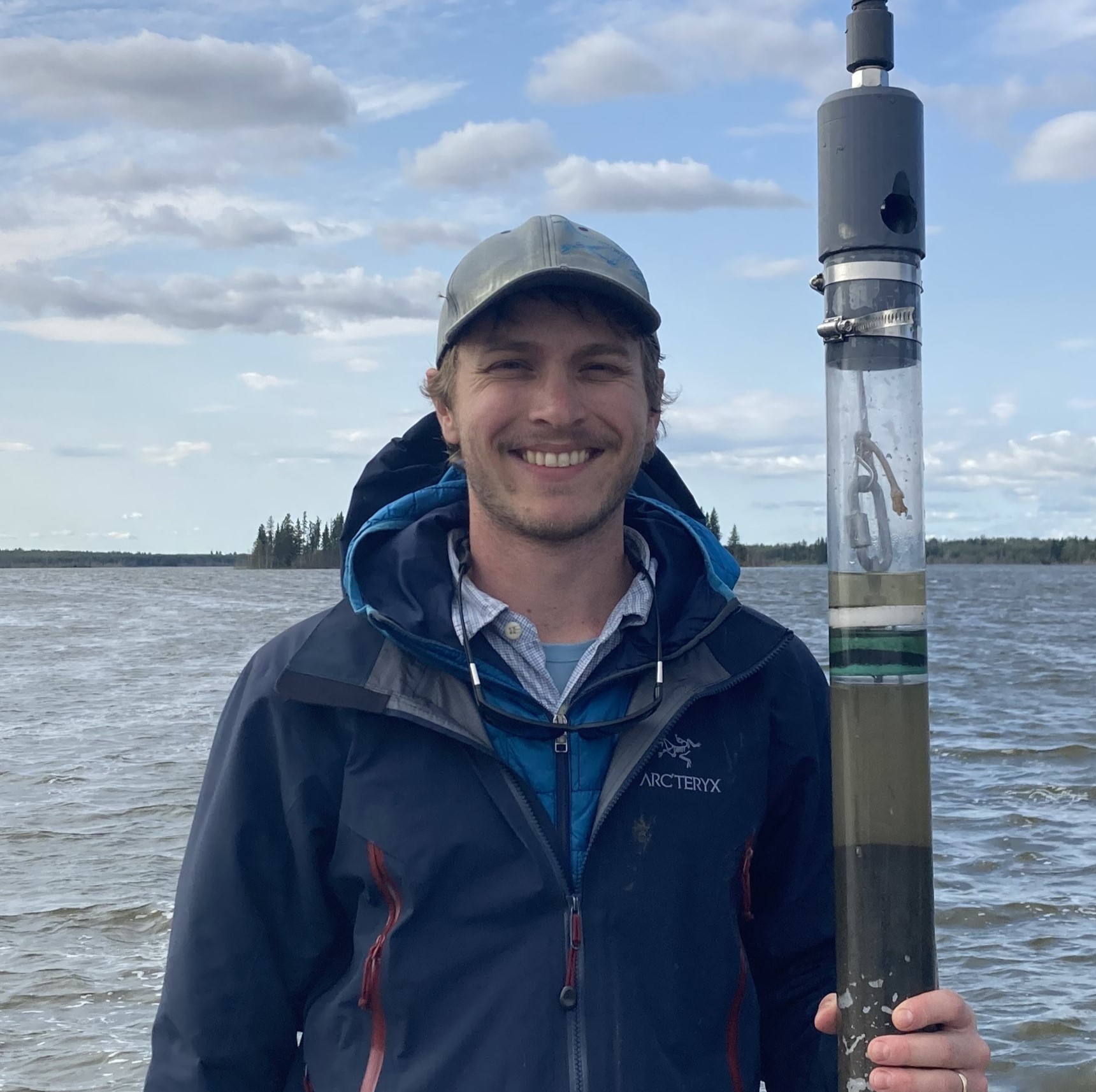
Image description: John holding a sediment core near a lake.
Reconstructing Past Herbivore Ecology with Bones and Biomarkers
Despite their critical role in shaping terrestrial ecosystems, large herbivores remain underrepresented in paleoecological studies. Methodological advances enable us to reconstruct herbivore distribution, abundance, and ecological impacts across millennia. By analyzing radiocarbon-dated fossil datasets in a species distribution modeling framework, we characterized the changing climate envelope of American bison since the Last Glacial Maximum. These fossil based reconstructions, when paired with paleofire records, reveal regional-scale consumer dynamics where herbivores dominated biomass consumption in dry environments and fire prevailed in wetter settings in Holocene North America. Additionally, analysis of fecal steroid biomarkers in lake sediments provided a continuous record of local ungulate community composition and ecological impacts in Yellowstone National Park. Together, these advances reveal interactions between herbivores and their environments through time, challenging conventional ecological narratives and providing crucial historical context for modern conservation and restoration initiatives.
Viktor Radermacher
University of Minnesota, USA
April 8, 2025

Image description: Viktor holding two halves of an endothiodon snout.
Quantifying Performance of Ornithischian Dinosaur Dental Batteries
With a startling array of morphological diversity, large range in body masses, and relatively high abundance in the fossil record, Ornithischia’s evolutionary success is almost self-evident. However, this success is mostly realised by Ceratopsians and Hadrosauroids in the Cretaceous and has been attributed – in large part – to the independent evolution of dental batteries in both groups. Dental batteries are densely packed arrangements of teeth with highly conserved waves of eruption that uniformly wear to produce a complex and consistent wear surface for orally processing vegetation. Dental batteries have long been touted as “highly efficient” systems responsible for the late boom in ornithischian macroevolutionary success – but are they actually efficient? Using CT and surface scan data hand collected from museum specimens, I explore the interplay between key dental performance measures and body mass at individual and evolutionary scales, and make a case for us needing to chew a little longer on all of these ideas!
 Pal(a)eoPERCS