James Mulqueeney

University of Southampton, UK
June 4, 2024
A transition to automated phenotypic methods
Three-dimensional imaging techniques, such as x-ray micro-computed tomography (micro-CT), have revolutionised the characterisation of internal and external structures in diverse objects, enabling high-resolution visualisation and quantification of intricate features. Despite these advancements, rapid and accurate feature extraction from these images remains challenging, particularly with increasing trait complexity. This shortcoming highlights the need for new technologies that facilitate the consistent and repeated extraction and analysis of large amounts of phenotypic data. In this talk, I explore how advanced computational methods, including deep learning and landmark-free morphometrics, can offer a more efficient and reliable framework for analysing complex 3D traits. The findings highlight the potential of these methods to enhance our ability to understand and reconstruct phenotypic evolution by enabling large comparative analyses.
Nicolò Ardenghi

Here’s Nicolò (a man with fair skinned European features, brown hair) smiling gently and wearing a blue shirt. The backdrop features the lush green mountains of the karstic Lessinian plateau (one of his favourite spots in the SE Alps) partially obscured by clouds.
University of Colorado, Boulder, USA
June 18, 2024
The Holocene fire history of northeast Iceland between natural and anthropogenic forcings
Iceland’s Holocene paleoclimate provides key insights into climate dynamics in the northern North Atlantic, crucial for global heat distribution. The interplay of cooling, volcanism, and human influence on local environmental changes, such as fire and soil erosion, is debated. Our study introduces the first continuous Holocene fire record for Iceland, using PAHs and faecal sterols from lacustrine sediments to trace fire dynamics and human presence. Findings reveal four pivotal phases in the fire regime, with natural factors primarily controlling fires throughout the Holocene. Despite increasing aridity and fire-prone vegetation, human activities may have suppressed fire frequency post-settlement.
Alice Paine

An image of Alice, a woman with blonde hair, blue eyes, and wearing a black fleece smiling while stood in a cave built in near-black volcanic rocks.
University of Oxford, UK
June 25, 2024
Exploring the Quaternary mercury cycle
The mercury (Hg) cycle is significant on a global scale, due to the negative impacts of Hg bioaccumulation on terrestrial ecosystems. Increasing human activity has impacted this cycle through (1) potentially irreversible perturbation to the global temperatures, precipitation patterns, and atmospheric circulation, and (2) mass Hg contamination of terrestrial and aquatic environments. A mechanistic understanding of terrestrial Hg cycling on long (>1000-years) timescales is therefore crucial: to assess how natural, and human-induced climate changes may alter the speed, intensity, and balance of this cycle in the future. Aquatic sediments are one of the most effective Hg ‘sinks’ across a range of timescales, and ancient lakes (>1 million years old) present a unique opportunity to study the terrestrial Hg cycle over multiple millennia. The sediments accumulated within these basins comprise a combination of allochthonous (externally sourced) and autochthonous (internally produced) materials, meaning that changes in sedimentary composition can record environmental shifts associated with climate-driven changes in temperature and atmospheric circulation. Hence, sedimentary archives can also provide time-resolved records of past variability in the terrestrial Hg cycle in response to different processes, feedbacks, and shifts in ecosystem structure on timescales ranging from centuries to multiple millennia. In this talk, I will present three new sedimentary Hg records sourced from the lakes in Southeast Europe (lakes Prespa and Ohrid, Balkan Peninsula), and West Africa (Lake Bosumtwi, Ghana): to explore how size, hydrology, catchment structure, and depositional setting may influence how differently (or similarly) these records encode changes in the Hg cycle, and how this information can be integrated with other high-resolution paleoclimate archives to consider how human-induced perturbations could amplify these natural changes in the future.
Jeanette Pirlo

California State University Stanislaus, USA
July 2, 2024
Stompin’ Through the Marshes: A Look at Gomphotheres from North-Central Florida
Most people know about mammoths, but have you heard about the four-tusked elephant-relative, the Gomphothere?! During Dr. Jeanette Pirlo’s talk, we’ll examine a new 5.6-Million-Year-Old site in Florida with over 40 individual gomphotheres ranging from newborns, all the way to very old individuals. We’ll discuss their diet, compared to the diet of the other herbivores that shared the gomphothere’s habitat, and the structure of the population as well as potential competitive interactions with the rhinoceros, Teleoceras. Come and imagine what is was like stompin’ through the marshes with the Gomphotheres.
Jana Burke
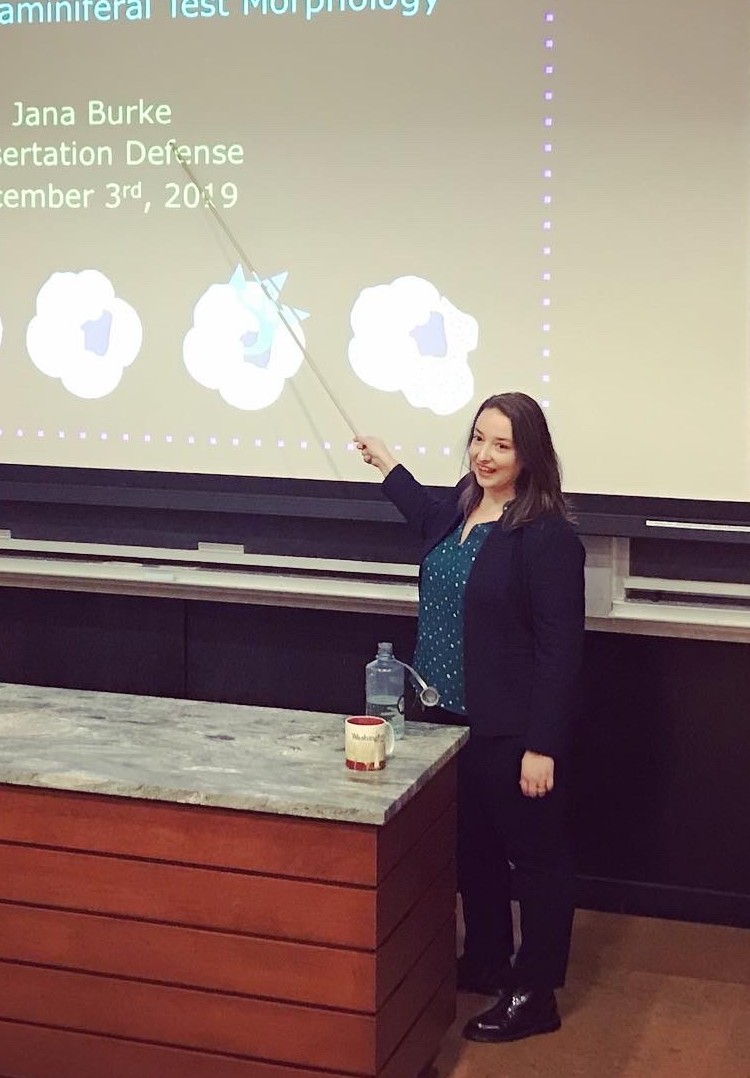
Michigan State University, USA
July 9, 2024
Investigating and Applying the Foraminiferal Iodine-to-Calcium Proxy using Living and Fossil Foraminifera
The foraminifera iodine-to-calcium proxy (I/Ca) can be used to detect the presence of oxygen deficient zones in the past. In this talk, I will discuss ongoing work to understand how foraminifera accumulate iodine and reflect local redox conditions. I will also discuss new results from fossil foraminifera spanning the Miocene Climatic Optimum (~14.5-17ma) which provide insight to the geographic distribution of marine ODZs during this greenhouse interval.

Life and Science on the JR
A handful of scientists and marine technicians will share their experience sailing aboard the JOIDES resolution for Expedition 403: Eastern-Fram Strait Paleo Archive. With each individual having a range of sailing experience, from first-timers at sea to a handful of expeditions under their belt, the group is happy to speak about life aboard the ship, science at sea, challenges sailing, and individual scientific specializations.

200 million years of crocodylomorph evolution: systematics, paleoecology and macroevolution
Crocodylia is the crown-group formed by the most recent common ancestor of living crocodiles, alligators, caimans and gharials and all of its descendants. It is a currently depauperate group, with only nearly 30 extant species. Nevertheless, the fossil record shows a different, much richer story. Crocodylomorpha, the group that includes Crocodylia and its closest extinct relatives, has nearly 500 species described and an evolutionary history of more than 200 million years, since the Late Triassic. It is a group of remarkable morphological disparity and surprising ecological diversity, with some of its members exhibiting a morphology and lifestyle hardly associated with a living crocodile. In this talk, we will explore the group’s diversity, systematics and evolution, through a number of different studies conducted by the speaker.
Nare Ngoepe
University of Copenhagen, Denmark
September 10, 2024
The evolutionary diversification of cichlid fishes reconstructed from sedimentary deposits
Adaptive radiations are central in providing insights and understanding of processes and mechanisms that trigger diversification, but understanding the sequence of events leading to them is challenging, especially because most classical examples occurred millions of years ago. The rapid radiation of Lake Victoria haplochromine cichlids, with over 500 species emerging in the past ~17,000 years, is an exception. So far, research on this diversification relied on comparative biology and phylogenetic trees, which are informative but lack fossil data insights. Here, I introduce a fossil perspective from lake sediments to test long-standing hypotheses of adaptive radiation and species loss.

Understanding the feeding habits of extinct caimans through empirical approaches: FEA and Gape Analysis
Finite element analysis (FEA) and gape analyses are empirical computational techniques that only relatively recently have begun to be employed for studies on the paleoecology of extinct organisms. Topics that can be approached through such techniques include bite force estimates (FEA) and estimations of maximum opening of the mandible (gape analysis), both of which can significantly help us to understand the feeding behavior of extinct forms, including crocodylians. The talk will be about the employment of these techniques in the investigation of the feeding behavior of four South America extinct caimans: Acresuchus (an alleged generalist), Caiman brevirostris (a putative durophagous), Mourasuchus (a proposed gulp-feeder), and Purussaurus (one of the largest crocodylians of all time).
 Pal(a)eoPERCS