Parth Shah
University of Haifa, Israel
December 5, 2023
Late Holocene climate reconstruction from the southern Arabia: A tale of two monsoons and two lakes
The Arabian Desert is considered a climate-sensitive zone that is susceptible to changes in the Indian monsoon fronts. Its unique location offers a valuable opportunity to study the interactions between monsoons, shifts in the Inter-Tropical Convergence Zone (ITCZ), and regional environmental changes. This talk will provide an overview of the lack of information on climate variability in the southern margins of the Arabian Peninsula through the integration of a set of physical, chemical, and biological proxies on sedimentary core sequences retrieved from volcanic crater lake Karif Shawran and karstic lake Gayal el Bazal. Furthermore, this study reveals for the first time a continuous lacustrine record from southern Yemen that reliably responds to climate variability associated with the Medieval Climate Anomaly (MCA) and Little Ice Age (LIA). Moreover, this talk aims to explore the onset and extent of climatic events, the main driving forcing behind hydroclimatic changes in the region, and shed light on the role of the ITCZ vis-à-vis monsoonal dynamics.
Alejandro Izquierdo López

University of Toronto, Canada
January 30, 2024
Bivalved arthropods: exploring the Cambrian origins of mandibulate arthropods
The arthropod group Mandibulata, which includes crustaceans, centipedes and insects, accounts for the majority of animal species on Earth. Understanding its evolutionary origins is a crucial question that may depend on a series of carapace-bearing arthropods discovered across Cambrian sites of exceptional preservation. Recent discoveries of their anatomy, analyses of their morphological diversity and ecological inferences provide us with valuable clues but also open the door for new questions.
Frederick Tolchard
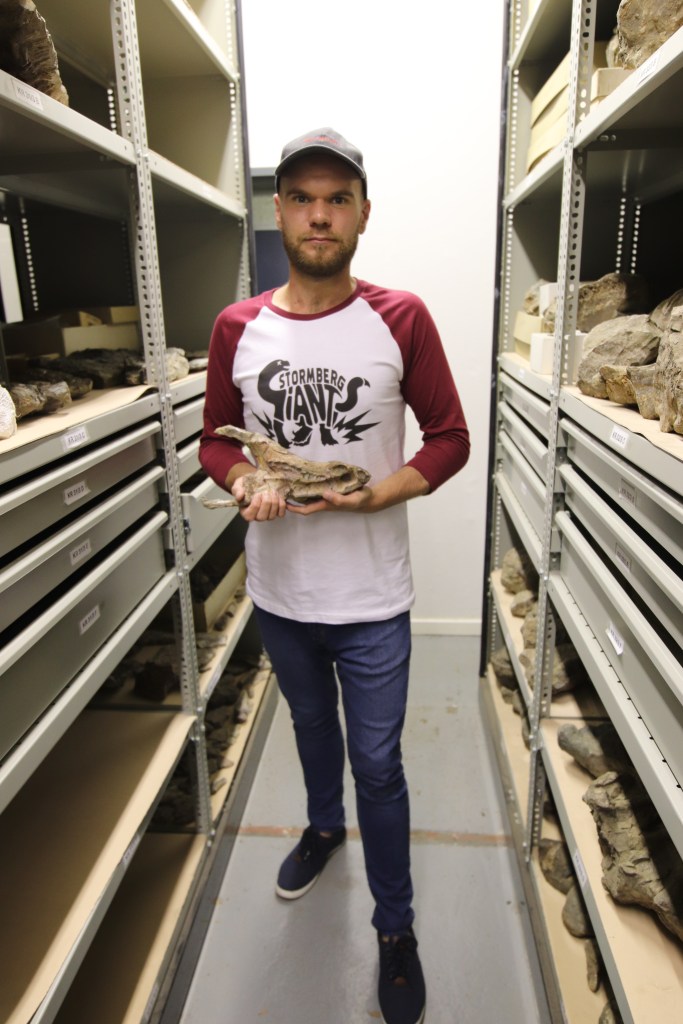
specimen in view of the camera.
University of the Witwatersrand, South Africa
February 06, 2024
The Triassic of Southern Africa: Life and rebirth from mass extinction to extinction
The Triassic Period (250-200 mya) represents a pivotal time in the evolution of life on earth. The Triassic is bound by two mass extinction events: the devastating end- Permian Mass Extinction which and the faunal turnover of the Triassic-Jurassic extinction event which gave rise to the age of dinosaurs. Most major amniote
lineages (including mammals, crocodilians, birds, and turtles) originate in the Triassic. In this talk, I will be discussing the rich Triassic fossil record of southern Africa and its implications for our understanding of the evolution of terrestrial vertebrates globally.
Karen Gariboldi

Pisa University, Italy
February 20, 2024
Diatoms, from their morphology to their importance for palaeoceanography: an example from the Upper Miocene of the Ica Desert, Peru
In some cases, microfossils are the main constituent of sedimentary rocks. Diatoms, a type of microalgae with a siliceous exoskeleton, form vast marine or lake deposits known as ‘diatomites’. They thrive in every wet environment, from your garden ponds to the Pacific Ocean, thus being a great tool for paleoclimatic reconstructions. During this talk, we will investigate how they can be used as a proxy for the physical properties of the oceanic waters (temperature, stratification, presence of sea-ice etc.). This seminar will also illustrate a paleoceanographic reconstruction from the Upper Miocene of the Ica Desert, Peru.
Gabriel Osés
University of São Paulo, Brazil
February 27, 2024
Applying cutting-edge technology to investigate exciting research topics in biomineralization and soft-tissue preservation
Fossils provide a window into ancient worlds. The task of analyzing fossils gives to paleontologists a reward unique to their job: “time travel” with samples and tools on hand. Fascinating research is conducted everyday with simple tools. Other equally important investigations require cutting-edge technology, which enable a deep knowledge of fossil samples. The talk will be focused on how a multiproxy approach can test hypotheses in studies involving structure, composition and affinities of the early biomineralizing metazoans, and in research dealing with morphology and composition of preserved soft tissues.
 Pal(a)eoPERCS